Doctoral Defense of Carlos Zamora-Zapata
Dissertation Title: CRÍTICA CONTEXTURAL: EL CORAZÓN DEL INSTANTE DE ALBERTO BLANCO: ENSAYO DE UN MÉTODO
January 31st from 10-12AM
Doctoral Defense of Carlos Zamora-Zapata
Dissertation Title: CRÍTICA CONTEXTURAL: EL CORAZÓN DEL INSTANTE DE ALBERTO BLANCO: ENSAYO DE UN MÉTODO
January 31st from 10-12AM
With offerings from anthropology to WRD, UK Education Abroad is working to help more students study in Mexico.
“Los desadaptados de la modernidad: vanguardistas en la literatura de Iberoamérica”
JANUARY 16, 2014
Davis Marksbury Building – Hardymon Theater
5:00-6:30pm
Alejandro Palma Castro (México D.F., 1972). Doctor en Literatura y Lingüística Hispánicas por la University of Kentucky (E.E.U.U.) en 2001. Ha publicado y editado alrededor de 6 libros sobre temas de poesía y literatura hispanoamericana de los siglos XIX y XX. Así mismo ha publicado artículos y capítulos de libro sobre vanguardias literarias, literatura experimental y poesía visual mexicana. Es profesor de la Facultad de Filosofía y Letras de la Benemérita Universidad Autónoma de Puebla. Desde 2008 se desempeña como director de dicha facultad.
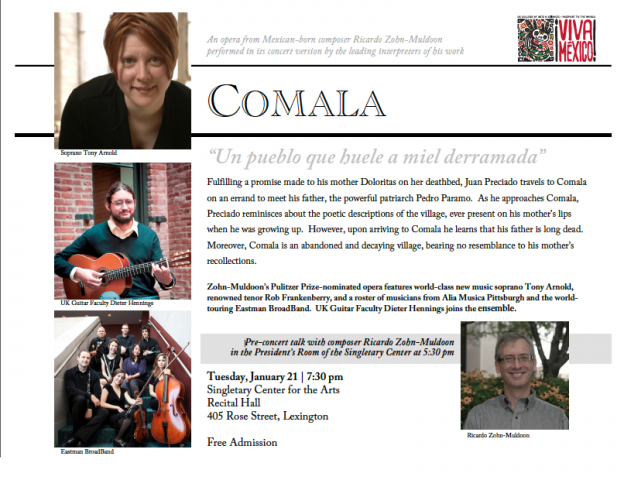
Zohn-Muldoon
’s Pulitzer Prize-nominated opera features world-class new music soprano Tony Arnold, renowned tenor Rob Frankenberry, and a roster of musicians from Alia Musica Pittsburgh and the world-touring Eastman BroadBand. UK Guitar Faculty Dieter Hennings joins the ensemble.
Comala, opera de Ricardo Zohn-Muldoon fue nominada a un Premio Pulitzer. La presentación en UK contará con la actuación de Tony Arnold (soprano), Rob Frankenberry (tenor), músicos de Alia Musica Pittsburgh y worldtouring Eartman BroadBand. Dieter Hennings, de la facultad de Guitarra de UK también será parte del show.
A Christmas tradition based on its Biblical Origins.
Title: Informatics and Modeling Platform for Stable Isotope-Resolve Metabolomics
Abstract: Recent advances in stable isotope-resolved metabolomics (SIRM) are enabling orders-of-magnitude increase in the number of observable metabolic traits (a metabolic phenotype) for a given organism or community of organisms. Analytical experiments that take only a few minutes to perform can detect stable isotope-labeled variants of thousands of metabolites. Thus, unique metabolic phenotypes may be observable for almost all significant biological states, biological processes, and perturbations. Currently, the major bottleneck is the lack of data analysis that can properly organize and interpret this mountain of phenotypic data as highly insightful biochemical and biological information for a wide range of biological research applications. To address this limitation, we are developing bioinformatic, biostatistical, and systems biochemical tools, implemented in an integrated data analysis platform, that will directly model metabolic networks as complex inverse problems that are optimized and verified by experimental metabolomics data. This integrated data analysis platform will enable a broad application of SIRM from the discovery of specific metabolic phenotypes representing biological states of interest to a mechanism-based understanding of a wide range of biological processes with particular metabolic phenotypes.
Rosalinda Rodríguez from Jalapa, Veracruz in Mexico tells us a little about Day of the Dead celebrations in Mexico.